
We may earn money or products from the companies mentioned in this post.
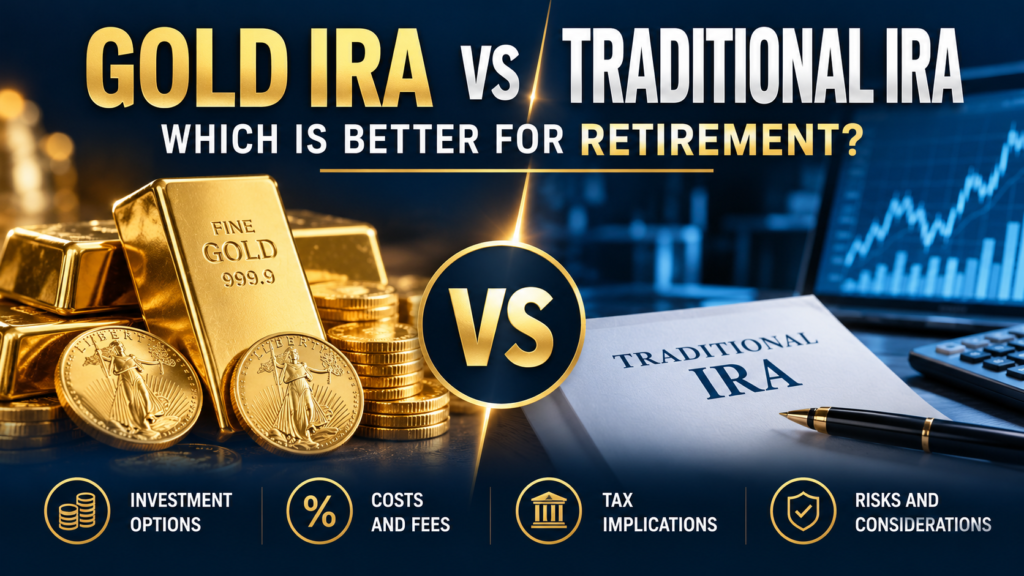
Choosing between a Gold IRA and a traditional IRA is not necessarily an either-or decision. Both can offer tax-advantaged retirement saving, but they differ in what you can hold, what you pay, and how easily you can manage your investments.
Exploring whether gold belongs in your retirement plan? Our guide to gold in an IRA covers seven considerations, costs and risks, with a link to compare Gold IRA providers before requesting written quotes.
A traditional IRA is a type of retirement account with specific tax rules. A Gold IRA is generally a self-directed IRA that holds qualifying physical precious metals. A Gold IRA can itself be structured as a traditional IRA or a Roth IRA. That distinction matters when comparing your options.
Gold IRA vs Traditional IRA: Quick Comparison
| Feature | Conventional Traditional IRA | Gold IRA Holding Physical Metals |
|---|---|---|
| Typical holdings | Stocks, bonds, mutual funds, ETFs and cash equivalents | Eligible gold and other qualifying precious metals |
| Tax treatment | Generally tax-deferred; deductibility depends on eligibility | Depends on whether the self-directed account is traditional or Roth |
| Income potential | Some investments may pay interest or dividends | Physical gold does not pay interest or dividends |
| Ongoing costs | Brokerage and fund fees vary | Custodian, storage, insurance and transaction costs may apply |
| Liquidity | Publicly traded assets can often be sold relatively quickly | Physical metal sales may involve dealers, spreads and processing time |
| Main risks | Market losses and investment-specific risks | Gold price volatility, fees, dealer spreads and concentration risk |
These are typical differences, not guarantees. Account terms, investments and fees vary by provider.
What Is a Traditional IRA?
A traditional individual retirement arrangement (IRA) is a retirement account that may allow tax-deductible contributions, subject to income, filing status and workplace retirement-plan rules. Investments can generally grow without annual tax on gains inside the account. Withdrawals are typically taxable, and early distributions may trigger additional tax unless an exception applies.
Many conventional IRAs are offered through brokerages, banks and other financial institutions. They often give investors access to diversified stock and bond funds, individual securities and cash-like investments.
The key advantage is flexibility: you can build a portfolio across multiple asset classes, often with relatively low-cost investment options.
What Is a Gold IRA?
A Gold IRA is commonly a self-directed IRA established to hold certain IRS-permitted physical precious metals. The account needs an appropriate custodian, and the metals must satisfy applicable eligibility and custody requirements. Not every gold coin or bar qualifies.
Despite the name, a Gold IRA is not a separate tax category. Its tax treatment depends on the underlying IRA structure. For example, a traditional self-directed Gold IRA generally follows traditional IRA distribution rules.
Investors usually buy metals through a dealer and arrange qualified custody and storage. These additional parties can make a physical Gold IRA more expensive and less straightforward than a standard brokerage IRA.
For a closer look at the process, read our Gold IRA setup guide.
Five Important Differences
1. Investment choice and diversification
A conventional IRA can hold a broad selection of financial assets. A physical Gold IRA focuses on eligible precious metals. Gold may behave differently from stocks and bonds in some market conditions, but its price can also fall sharply. Holding only gold is not the same as holding a diversified retirement portfolio.
2. Costs and fees
Traditional brokerage IRAs may have low account fees, although investment expenses still matter. Physical Gold IRAs can involve setup charges, annual custodial administration, insured storage, dealer premiums over the metal’s market price, and spreads when selling.
These expenses can reduce long-term returns, particularly for smaller accounts. Our Gold IRA fees guide explains what to ask providers before opening an account.
3. Growth and income
Stocks can appreciate and may pay dividends; bonds can provide interest, though neither outcome is guaranteed. Physical gold generates no cash flow. Its investment return depends largely on the price at which it can eventually be sold, after costs.
4. Liquidity and access
Many publicly traded investments in a brokerage IRA can be sold during market hours. Selling physical gold through an IRA can require coordination with the custodian and dealer, and the buyback price may be below the quoted retail selling price.
5. Storage and account rules
With a conventional IRA, securities are typically held through the financial institution. Physical precious metals in an IRA have additional custody requirements. Be wary of claims that you can simply take IRA-owned gold home without tax consequences. Ask a qualified tax professional about any proposed storage arrangement.
Can You Have Both a Traditional IRA and a Gold IRA?
Yes. Investors may hold more than one IRA, including a conventional brokerage IRA and a self-directed IRA holding qualifying metals. However, annual contribution limits generally apply across your IRAs collectively rather than separately to each account. Eligibility, contribution limits and required distributions depend on your circumstances and current IRS rules.
For some investors, a small allocation to precious metals may complement a wider portfolio. The appropriate amount, if any, depends on risk tolerance, investment horizon, costs and overall retirement needs.
Can You Move Money From a Traditional IRA to a Gold IRA?
It may be possible to transfer eligible IRA funds to a self-directed IRA that can purchase qualifying metals. A direct trustee-to-trustee transfer is different from receiving a distribution yourself and then attempting to roll it over. Indirect rollovers can be subject to deadlines and restrictions, including the 60-day rule and, for certain IRA-to-IRA rollovers, a one-per-year limitation.
Rules also differ for workplace retirement plans such as 401(k)s. Confirm eligibility and instructions with both custodians and, where relevant, your plan administrator before moving funds.
Read our Gold IRA rollover rules guide for the practical differences and common mistakes.
Who Might Prefer a Conventional Traditional IRA?
A conventional IRA may be more suitable if you value a broad selection of investments, lower-cost index funds, straightforward account management and the ability to rebalance easily. It can also be attractive if you want exposure to assets that may produce dividends or interest.
Who Might Consider a Gold IRA?
A physical Gold IRA may interest someone who specifically wants to hold eligible tangible precious metals within a retirement account and understands the added storage, custody and trading costs. It should not be treated as a guaranteed inflation hedge, a risk-free safe haven or a substitute for diversification.
Questions to Ask Before Choosing
- What percentage of my retirement savings would be concentrated in precious metals?
- What is the full first-year and ongoing cost, including dealer markups and selling spreads?
- Who is the IRA custodian, and where will the metals be stored?
- What metals are eligible, and how are prices determined?
- How long does it take to sell or distribute the holdings?
- How do taxes, required minimum distributions and beneficiary rules apply to my situation?
Frequently Asked Questions
Is a Gold IRA safer than a traditional IRA?
Not automatically. Physical gold avoids some company-specific risks but introduces commodity price volatility, storage expenses and transaction costs. The safety of any IRA depends largely on its investments and how diversified the overall portfolio is.
Does a Gold IRA have the same tax benefits as a traditional IRA?
A self-directed Gold IRA set up as a traditional IRA generally follows traditional IRA tax rules, provided it is operated in compliance with applicable requirements. A Roth Gold IRA follows a different tax framework.
Can I hold gold ETFs in a regular IRA?
Many conventional brokerage IRAs permit investments in exchange-traded products that provide gold exposure. These are not the same as owning physical bullion in a self-directed IRA; product structures, fees and risks vary.
Can I keep my Gold IRA coins at home?
Do not assume so. IRA precious-metal custody is subject to strict requirements, and personal possession can create significant tax problems. Obtain professional guidance before acting on any home-storage claim.
The Bottom Line
A conventional traditional IRA is often simpler and more flexible for building a diversified retirement portfolio. A physical Gold IRA offers a different form of exposure to precious metals, but usually adds costs, complexity and concentration risk. Neither is universally better. Compare the actual investments, fees and tax implications rather than relying on promotional claims.
For official information, consult the IRS IRA overview and IRS Publication 590-A. Consider speaking with an independent, qualified financial or tax adviser before making retirement-account decisions.
Disclaimer: This article is for general education only and is not personalised investment, legal or tax advice. Investing involves risk, including possible loss of principal. Rules and limits can change.