
We may earn money or products from the companies mentioned in this post.
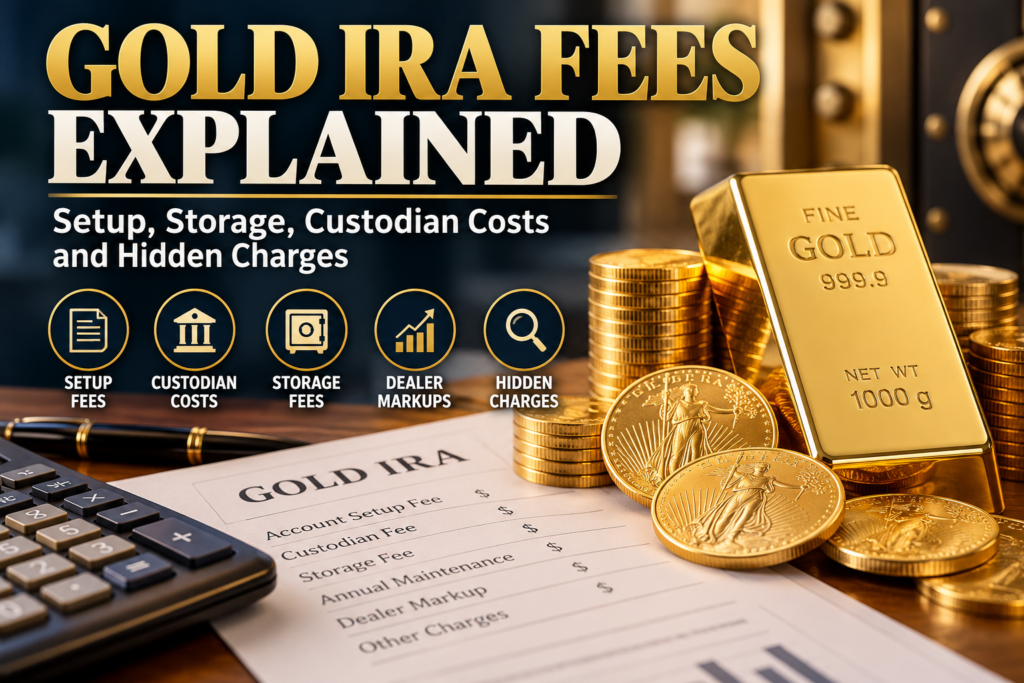
Gold IRA fees can have a significant effect on your long-term investment results. Before opening a self-directed individual retirement account that holds eligible physical precious metals, understand what you may pay to establish the account, purchase metals, store them, maintain the account and eventually sell or distribute the assets.
Exploring whether gold belongs in your retirement plan? Our guide to gold in an IRA covers seven considerations, costs and risks, with a link to compare Gold IRA providers before requesting written quotes.
This guide explains the main cost categories, the questions to ask providers and a practical way to compare quotes. It is educational information, not personalised financial or tax advice.
What is a Gold IRA?
A Gold IRA is commonly used to describe a self-directed IRA that invests in certain eligible physical gold or other precious metals under US retirement-account rules. The IRA typically involves a custodian or trustee, a precious-metals dealer and an approved storage arrangement. Not every gold coin or bar qualifies for an IRA, and buying metal personally is not the same as purchasing eligible metal through an IRA.
Start with our Gold IRA setup guide for an introduction to the process.
1. Account setup and establishment fees
Some custodians charge a one-time fee to establish a self-directed IRA. Others bundle the initial paperwork into a wider package or waive certain charges as part of a promotion. Ask whether the advertised fee covers account opening, transfers or rollovers, and any necessary documentation.
Ask: Is the setup charge one-time? Are there separate charges for transfers, rollovers, account amendments or closing an existing account?
2. Annual custodian and administration fees
Self-directed IRAs often have ongoing administration charges. Depending on the custodian, the charge may be a flat annual amount, based on asset value or calculated using another fee schedule. Some services, such as paper statements, wire transfers or account termination, may carry additional charges.
Ask: What is the complete annual fee schedule, and does the fee increase as the account grows?
3. Precious-metals storage fees
Eligible physical metals held in an IRA generally must be held through the required trustee or custodial arrangement, rather than simply kept in your home. Storage costs can depend on the depository, insurance arrangements, the value or quantity of metal and the type of storage selected.
Segregated versus non-segregated storage
Providers may offer different storage arrangements. In a segregated arrangement, your holdings are identified and stored separately according to the depository’s terms. In a non-segregated or commingled arrangement, eligible holdings may be stored alongside other clients’ metal while ownership is recorded in the relevant accounts. Exact terms vary, so obtain the depository’s written explanation rather than assuming the labels mean the same thing everywhere.
Ask: Who operates the depository? Is storage insured, by whom and subject to what limits or exclusions? What does it cost to switch storage arrangements or take a distribution?
4. Dealer markups and the buy–sell spread
This is one of the most important costs to understand. A dealer’s selling price for coins or bars may be higher than the market’s quoted spot price for the underlying metal. When you sell, the dealer’s buyback price may be lower than its selling price. The difference is often described as the spread.
Spot prices are useful reference points, but they are not necessarily the prices at which you can buy or sell specific retail products. Premiums may vary by product, market conditions and transaction size. A low annual account fee does not automatically mean the overall investment is inexpensive if the dealer’s spread is large.
Ask: For the exact products proposed, what is today’s total purchase price, how does it compare with the current spot price, and what would the dealer pay to repurchase those same products today? Request this information in writing where possible.
5. Shipping, insurance, transaction and liquidation charges
Additional costs may arise when metals are shipped to a depository, moved between facilities, sold, or distributed. There may also be wire fees, transaction fees, insurance-related charges and fees for closing an account. Some providers include certain services in a package; others itemise them.
Ask: What would it cost, in total, to buy, hold and then liquidate the metals after one year, five years or ten years, assuming the metal price itself did not change?
6. Promotions and fee waivers: read the conditions
Promotions such as waived first-year fees can reduce initial costs, but they should not drive the whole decision. Check minimum investment requirements, which charges are covered, whether the waiver is funded by a higher metal premium and what happens after the promotional period ends.
A practical Gold IRA fee comparison checklist
Before choosing a provider, request a written, itemised illustration for the same investment amount and comparable metal products. Use this checklist:
- One-time account establishment and transfer charges
- Annual custodian and administration charges
- Annual depository storage and insurance charges
- Exact metals proposed, quantities and purchase prices
- Difference between quoted metal prices and the relevant spot reference
- Dealer buyback terms and illustrative resale prices
- Shipping, wire, transaction, liquidation and closure charges
- Any minimum purchase, ongoing balance or promotional conditions
- Who provides custody, storage and customer support
Example: why total cost matters
Consider two hypothetical arrangements. Provider A charges less each year but has a higher purchase premium. Provider B has higher annual administration fees but a lower initial premium. Which is cheaper depends on how much you invest, what you buy, how long you hold it and the price you receive when selling. This is why a single headline fee or a “free storage” offer is not enough for a fair comparison.
Ask each provider for a written illustration using the same assumptions, and remember that future precious-metals prices are unpredictable.
Are Gold IRAs right for everyone?
No. Gold and other precious metals can be volatile, do not generate interest or dividends merely by being held, and may involve storage, transaction and liquidity costs. Concentrating retirement savings in one asset type increases risk. Tax treatment, eligible metals, distributions and rollover rules can also be complex. A qualified, independent professional can help assess whether an arrangement is appropriate for your individual circumstances.
Next steps: research before committing
If you’re exploring a Gold IRA, begin with our Gold IRA setup guide, then read our Augusta Precious Metals comparison as one starting point for further research. Always confirm current fees, products and terms directly with the relevant businesses.
Frequently asked questions
Does every Gold IRA charge the same fees?
No. Custodians, dealers and depositories have different pricing models. Ask for a complete written breakdown before making a decision.
Is the annual custodian fee the only ongoing cost?
Not necessarily. Storage, insurance and other administration charges may be billed separately.
Can I keep IRA gold at home to avoid storage fees?
Do not assume so. IRA custody and possession rules are restrictive, and incorrect handling can create serious tax consequences. Seek qualified advice before considering any arrangement advertised as “home storage.”
Do dealers always buy back metals at the price I paid?
No. Buyback prices depend on prevailing market conditions, product demand and the dealer’s pricing policy. There is no general guarantee that you can recover your purchase price.
Disclosure: This article is for general information only and does not constitute investment, tax or legal advice. Precious metals involve risk, including possible loss of capital. We may receive compensation from qualifying referrals in future; see our Affiliate Disclosure and Financial Disclaimer.